Abhinav Roy
UG III
Roll no. : 26
Abstract: One of the most important ideas in Fyodor Dostoevsky’s The Idiot is that of Christ, his meaning and his relevance in the modern world. Other equally important themes dealt with in the novel, such as death, time, and the nature of love, among others, are themselves associated with the novel’s exploration of the meaning of Christianity. This paper makes a rudimentary examination of some of the fundamental tenets of Christianity, particularly in the Russian Orthodox Church, in order to fully appreciate the religious thrust in The Idiot, and better comprehend the connection that the author establishes between Christ and the protagonist of the novel, the eponymous “Idiot,” Prince Lyov Nikolayevitch Myshkin.
Prince Myshkin, whom Dostoevsky described as a “perfectly beautiful man”1 (the ideas of perfection, beauty, and of man are meticulously examined in the novel), serves in many ways as a reflection of Christ himself, especially as Christ was understood in the Russian Orthodox Church. A particularly important aspect of Christ’s nature in the Russian church is the idea of kenosis2, a Greek word that means “emptying out.” In Christian theology, kenosis alludes to the renunciation of the divine nature, at least in part, by Christ in the Incarnation. In simple words, it refers to Christ’s act of humbling himself in becoming a man and in suffering death. St. Paul counsels his followers to imitate Christ, “who, though he was in the form of God, did not regard equality with God as something to be exploited, but emptied himself, taking the form of a slave, being born in human likeness. And being found in human form, he humbled himself and became obedient to the point of death – even death on a cross” (Philippians 2:6-8). The idea of Christ as meek and humble is part of the core of Russian religious belief.3 Myshkin himself displays a similar humility. He also exhibits an extraordinary ability to sympathise with everyone he meets, to join with them in fellow feeling. He comes close to the Christian ideal of a universal love for all. Myshkin’s love for Nastasya Filippovna falls into this category. When he first beheld the photograph of Nastasya in General Epanchin’s room, Myshkin stands entranced, saying:
‘It’s a wonderful face… and I feel sure her story is not an ordinary one. The face is cheerful, but she has passed through terrible suffering, hasn’t she? Her eyes tell one that, the cheek bones, those points under her eyes. It’s a proud face, awfully proud, but I don’t know whether she is kind-hearted. Ah, if she were! That would redeem it all!’ (pp. 38-39)
A few hours later, Myshkin once again finds himself standing transfixed in front of the portrait:
He looked round, went to the window nearer to the light, and began looking at the portrait of Nastasya Filippovna.
He seemed trying to decipher something that had struck him before, hidden in that face. The impression it had made had scarcely left him, and now he was in a hurry to verify it again. He was now even more struck by the face, which was extraordinary from its beauty and from something else in it. There was a look of unbounded pride and contempt, almost hatred, in that face, and at the same time something confiding, something wonderfully simple-hearted. The contrast of these two elements roused a feeling almost of compassion. Her dazzling beauty was positively unbearable – the beauty of a pale face, almost sunken cheeks and glowing eyes – a strange beauty. Myshkin gazed at it for a minute, then started suddenly, looked round him, hurriedly raised the portrait to his lips and kissed it. When he walked into the drawing-room a minute later, his face was perfectly calm. (pp. 87-88)
Madame Epanchin, however, regards Nastasya as a woman of fallen social status, and contemptuously remarks to the Prince:
‘Yes, good-looking… very good-looking. I’ve seen her twice; only at a distance. That’s the sort of beauty you appreciate, then?’ she suddenly said to Myshkin.
‘Yes, it is,’ answered Myshkin with some effort.
‘You mean, just that sort of beauty?’
‘Just that sort.’
‘Why?’
‘In the face… there is so much suffering,’ answered Myshkin, as it were involuntarily speaking to himself, not in answer to her question. (p. 88)
As Myshkin remarks himself, his primary feeling for Nastasya Filippovna is that of pity. He loves her for her wounded, wronged soul; he loves her because she has suffered. An anachronistic comparison may be made here to mention Scobie, the protagonist of one of Graham Greene’s four major Catholic novels, The Heart of the Matter4 (1948), published almost eighty years after Dostoevsky’s Idiot. Herbert Haber, in his essay, ‘The Two Worlds of Graham Greene’5, hails “Greene as a religious novelist of that tradition which runs from Dostoevsky through Mauriac.” Scobie, like Prince Myshkin, was very much aware of “the meanness of life,” and out of “an overdeveloped sense of pity and responsibility,” believed that he “could love human beings nearly as God loved them.” As James Wood explains in his introduction6 to Greene’s novel – in his love for his wife, it is only when she was in her most cheerless, vulnerable state that Scobie’s “pity and responsibility reached the intensity of a passion.” In the New Testament there are several episodes in which Christ defends fallen women from their self-righteous attackers. Myshkin, in loving and defending Nastasya Filippovna, is behaving like Christ on earth.
But Myshkin is not a divine being; he is only a man, as Romano Guardini7 insists; a man whose existence is made up of purely human elements: body and soul, sorrow and joy, his inheritance and his poverty, his fortune and his misfortune. He has human longings, too. His love for Aglaia is quite different from the compassionate love he has for Nastasya Filippovna. When asked by the General’s wife whether he had noticed their youngest daughter, Aglaia, Prince Myshkin replies:
‘You are exceedingly beautiful, Aglaia Ivanovna. You are so beautiful that one is afraid to look at you.’
‘Is that all? What about her qualities?’ Madame Epanchin persisted.
‘It’s difficult to judge beauty; I am not ready yet. Beauty is a riddle.’ (pp. 84-85)
While Myshkin’s reply can be construed as his attempt to elude Madame Epanchin’s increasingly probing questions, Guardini shrewdly reminds us that Myshkin is a man whose very nature compels him to speak the truth in all circumstances. Therefore, it can be inferred that he is genuinely ruminating on the nature of beauty itself. But it is certainly clear that his feelings for Aglaia are not driven by pity or compassion, as they are for Nastasya. No, his love for Aglaia is of a romantic and personal nature. How can the individual, romantic love that Myshkin feels for Aglaia, asks Anne Hruska in her introduction8 to The Idiot, coexist with the universal love he feels for the world and especially for the wounded, vulnerable Nastasya Filippovna? Are romantic love and Christian love necessarily at odds?
Dostoevsky had considered these questions as they related to his own life several years earlier, after the death of his first wife, Maria, in 1864. Writing in his diary while sitting in the room in which his wife’s corpse lay, Dostoevsky ruminated on the meaning of marriage in relation to the afterlife. Christ, Dostoevsky wrote, is the embodiment of pure and all-encompassing love; he is an ideal love for humankind to emulate. Dostoevsky argues that the highest goal of the self “is as if to destroy the ego, give it up entirely to all and everyone without discrimination and without expecting a return. This is the highest happiness.”9 Joseph Frank argues that if this universal love is humanity’s task on earth, then marriage and family life must be selfish, since they require us to focus love on only a few people rather than on the entire world. “The family,” Dostoevsky writes, “is the most sacred thing for humanity on earth […] But at the same time, humanity, in following this law of nature, must negate its final goal.” Since people are as yet incapable of pure, Christ-like love, they must devote their love to their families.10 This, paradoxically, brings humanity both closer to and farther from its ultimate goal. The contradiction cannot be resolved in the present world, Dostoevsky decides. Love for all on earth is impossible until the Second Coming of Christ and the prophesied Kingdom of God. The Idiot portrays attempts to make this love work before its time as disastrous in both social and practical terms.11
Prince Myshkin is incapable of making compromises for the sake of social hierarchy and conventions. More often than not, he simply doesn’t understand these conventions at all, which often leads to his being called an idiot. But idiocy in and of itself is not always such a bad thing, especially in the Russian religious tradition. In the Russian church, there exists a strong tradition of the “holy fool,” drawn from St. Paul’s Epistle to the Corinthians, in which he writes, “We are fools for Christ’s sake, but you are wise in Christ” (1 Cor. 4:10). Some of the most beloved saints in the Russian church were “fools for Christ’s sake.” Holy fools scorned the pleasures of the flesh, often went barefoot in the winter, and frequently behaved in ways that could seem irrational and nonsensical. In nineteenth-century Russia, some people lived as holy fools, eating food given to them in charity and sleeping in the streets. Many of them might now be identified as insane. But the Russian church valued holy fools for devoting their lives to God for living in a love of Christ that had no use for practical concerns and that was higher than reason.
While Prince Myshkin, the idiot of the novel’s title, is far more reasonable than a classic holy fool, he does display several key traits of the tradition – his utter lack of respect for money, for example. The possibility of inheriting a great fortune does not appear to have much appeal for him. When, later on, he actually talks about the prospect of inheritance, it is vis-à-vis something else which interests him more, i.e. the prospect of being betrothed to Nastasya Filippovna. At first Prince Myshkin is poor, but evidently he does not notice it; he laughs with genuine mirth at all the jests Rogozhin and Lebedyev make at the expense of his little sack. Later he impetuously agrees to a loan of some roubles, not caring about losing his dignity in doing so. Another trait exhibited by Myshkin is his lack of interest in the social hierarchy. We are told on several occasions that Myshkin belongs to the upper class, and that his manners are refined. But it is palpable that he is not at ease in society, and often is even unseemly and embarrassed. The Prince’s willingness to tell the pure truth at all times can also be said to belong to the holy fool tradition. He is truthful not only in the sense that he never lies, rather, he expresses the recognized truth always and everywhere, completely indifferent to what outcome may occur from his doing so. However, while he defies social conventions, Prince Myshkin also tries to live within society, as holy fools never did. Thus one of the focal points of the novel is the exploration of how universal love works – or doesn’t work – in a world obsessed with social hierarchies. Indeed, capitalism run rampant is a recurring theme in Dostoyevsky’s work, and The Idiot is full of feverish narrations of the power of the ruble. Large sums of money seem to offer hope and salvation but all too often lead only to humiliation and destruction.
Dostoevsky was also particularly vexed with nihilism, a new kind of radicalism that acquired cultural prominence in the 1860s. Although their stated motto was to undermine the tsarist regime, the nihilists were, in verity, more bent on uprooting old social institutions and supplanting them with new social mores. Nihilists defined themselves as rational egotists, as introduced by the writer and scribe Chernyshevsky in his 1863 novel What Is to Be Done?12 It averred that those who live according to rational egotism act solely in their own self-interest as a matter of principle. Society will work better, Chernyshevsky tells us, if we recognize the egotism that underlies our every action, and frankly act accordingly. Dostoevsky was horrified by this idea, which he saw as a rationalization for all sorts of wicked behaviour. He was especially incensed by the atheism that was universal among nihilists. In denying Christ, Dostoesvsky felt, these radicals were opening themselves up to a destructive moral anarchy. The Idiot contains a number of portraits of nihilists, the most poignant of which is Ippolit, a consumptive young man grappling with his fear that his life means nothing in the face of his imminent death. Another issue that Myshkin and other characters are forced to confront is the problematic fact that we all must die. How does the inevitability of death affect our lives on earth? Does the fact that death is certain make life meaningless(the ‘absurd’ existential question addressed by Albert Camus in The Myth of Sisyphus13)? Or does life become all the more precious because of its finitude? Again, these questions have important implications in the Christian tradition. According to the New Testament, Christ was resurrected after his death and offers life eternal to the faithful. From the Christian perspective, life on earth is simply one stage of being, before progression to a new, far higher realm of existence. Several characters in The Idiot challenge this core Christian belief. Both Rogozhin and Ippolit, who is a staunch nihilist, refer to Holbein’s 1521 painting Christ in the Tomb and postulate that Christ in fact never did rise from the dead. This idea has terrifying implications within the context of the novel: if these characters are right, then the whole framework of Christian ideology falls to pieces, and eternal destruction is inevitable.
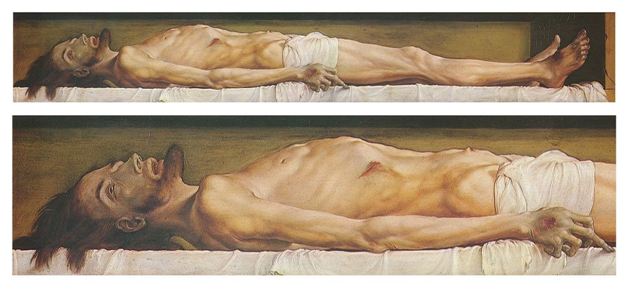
The painting is a grotesque depiction of the utterly emaciated body of Christ lying in his tomb. The realistic, detailed expression is almost intolerable, as what is most sacred finds itself lowered to the dread of annihilation. When Prince Myshkin first comes across the painting, arrested by its grotesqueness, a peculiar exchange ensues between him and Rogozhin:
‘And by the way, Lyov Nikolayevitch, I’ve long meant to ask you, do you believe in God?’ asked Rogozhin suddenly, after having gone on a few steps.
‘How strangely you question me and… look at me!’ Myshkin could not help observing.
‘I love to look at that picture!’ Rogozhin muttered after a pause, seeming again to have forgotten his question.
‘At that picture!’ cried Myshkin, struck by a sudden thought. ‘At that picture! Why, that picture might make some people lose their faith.’
‘That’s what it is doing,’ Rogozhin assented unexpectedly.
They were just at the front door.
‘What?’ Myshkin stopped short. ‘What do you mean? I was almost joking, and you are so serious! And why do you ask whether I believe in God?’
‘Oh, nothing. I meant to ask you before…’ (p. 245)
As strange as Rogozhin’s question to Myshkin may seem, for the latter has the most conspicuously religious presence about him, what is stranger is Myshkin’s reply to that question. It almost seems that for him, it is a question most incredible. He who in a certain sense lives in the presence of God does not obviously have to “believe” in God, for in his very existence, in his very being, he does not leave him. The attitude of Myshkin suggests that he does not have to confront God, like other men, because he, in a way, proceeds from God. The problem of God for Myshkin is therefore of a different nature, concludes Guardini. It is not for him to try and know what he needs to do in order to go to God or conduct himself in Him, but rather to know how to attain the fact of coming of God in a world tainted by cruelty, a world that is not godlike.
Concepts of death, love, and time come to a head in particular in discussions of the Apocalypse. As described in Revelation in the New Testament, the Apocalypse involves the Second Coming of Christ and the eventual end of the human world. What is the meaning of “the end of time,” as described in the novel? Does the end of time mean total, worldwide death and destruction? Or does it mean an ascent to a new and more perfect world, beyond the corruptive reaches of temporal reality?
Anne Hruska rightly concludes in her introduction to The Idiot that it would be a cop-out to say that Dostoevsky didn’t have an answer in mind to this and other questions. Dostoevsky had strong religious, social, and political beliefs, and he was never reticent about expressing them in his fiction. But one of the great things about Dostoevsky as a writer is that he’s just as powerful and just as much fun when you don’t agree with him as when you do. Dostoyevsky gives full and eloquent expression to a number of contrasting views on matters that were, to him, as important as life and death. He sometimes ridicules his opponents – the radicals, the atheists, the wealthy oppressors of the weak – but he never silences them. And so, despite the fact that Dostoyevsky wants to convey his beliefs and concerns to the reader, The Idiot is not, by any stretch of the imagination, propaganda. On the contrary, the novel offers a complex exploration of ideas that are crucial to the human experience.
WORKS CITED:
- Fyodor Dostoevsky, The Idiot (New York: Bantam Dell, 2005). All quotations from the novel are taken from this edition.
- George P. Fedotov, The Russian Religious Mind. (Cambridge, MA, Harvard University Press, 1946).
- Ziolkowski, Margaret, “Dostoevsky and the Kenotic Tradition,” Dostoevsky and the Christian Tradition, eds. George Pattison and Diane Oenning Thompson (Cambridge: Cambridge University Press, 2001), 31-40.
- Graham Greene, The Heart of the Matter. London: Vintage, 2004.
- Herbert R. Haber, The Two Worlds of Graham Greene. https://www.jstor.org/stable/26277067
- James Wood, ‘Introduction’ to The Heart of the Matter. Ibid.
- Romano Guardini and Francis X. Quinn, Dostoyevsky’s Idiot, A Symbol of Christ. https://www.jstor.org/stable/24456697
- Anne Hruska, ‘Why You Should Read The Idiot, And How Best To Go About It’ in The Idiot, Ibid.
- Fedor Mikhailovich Dostoevskii, Polnoe sobranie sochinenii., vol. 20 (Leningrad: Izd. “Nauka” 1972-1990), 177.
- Joseph Frank, Dostoevsky: The Miraculous Years, 1865-1871 (Princeton, NJ: Princeton University Press, 1995), 316-341.
- Liza Knapp’s article “Myshkin Through a Murky Glass, Guessingly,” in Dostoevsky’s The Idiot: A Critical Companion, ed. Liza Knapp (Evanston, IL: Northwestern University Press, 1998), 191-215. The discussion of the passage from Dostoevsky’s diary is drawn from Knapp’s article.
- Nikolai Chernyshevsky, What Is To Be Done? , first published in English in 1886.
- Albert Camus, The Myth of Sisyphus (London: Penguin Books, 2005).
IMAGE:
Hans Holbein the Younger, The Body of the Dead Christ in the Tomb, 1521 – Google Images https://www.google.com/search?q=hans+holbein+christ+in+the+tomb&rlz=1C1GIGM_enIN692IN692&source=lnms&tbm=isch&sa=X&ved=0ahUKEwjAhtOEmoXiAhVG7nMBHf46BokQ_AUIDigB&biw=1352&bih=603#imgrc=krKQV5kIv7ElXM:
Raktakarabi: Retelling mythology to create a postcolonial identity.
Ratul Dutta
UG3
001600401060
Abstract: Written at a time of acute political crisis Raktakarabi uses one of the mythology to recreate the idea of nation as well imbibe in it’s audience the structure of colonization that remained blurred to them for a long time. It mocks and critics at the same time how different indigenous institutions were duplicating the characteristics of their colonial masters. The paper tries to explore how the dynamic nature prevalent in the process of colonization and decolonization had been there since time immemorial thus aided intellects of all time to turn towards their mythology so that a greater number subaltern subjects can be reached.
The play Raktakarabi (Red Oleander) was written by Rabindranath Tagore between 1923 and 1924 and it got published as a text in 1926. As the dates of publication of the text suggest the play was written at a time of acute political turmoil in the history of India. At this point it becomes important to formulate the idea of ‘Post colonialism’. As the term suggests Post colonialism is not ‘simply a temporal divide signifying “after colonialism” rather a more holistic approach would be considering the term as an ideal of reverting back at the ‘legacies of colonialism’. Thus postcolonialism does not remain static between one particular strand of time and geographical location. Rather postcolonialism has been there from the beginning, it is contemporary of all time.
One of the important aspects of postcolonialism is the act of writing ‘history’ as it becomes very important to create the idea of the nation concerned. Dipesh Chakravarty in his essay and ‘Poscoloniality the artifice of History: Who Speaks for “Indian” pasts?’ points out how the academic discourse of history grew with “Europe” at its centre
“History as a discourse produced at the institutional site of the university –is concerned,” Europe” remains the sovereign theoretical subject of all histories….There is a peculiar way in which all these other histories tend to become variations on a master narrative that could be called “the history of Europe”
Thus it became very important for the subaltern subjects to write their own history as a first step towards creating their identity. It was not only out of ignorance but negligence that a major portion of their histories remained unrecorded in the European records rather it was deliberate on the part of the colonizers to appropriate the history of the colonized subjects according to their own needs. Thus Europe took it upon themselves the responsibility of rewriting the history of the ‘non western others’.
This act of writing history was done in various ways like retelling personal and family histories as it was done by Tagore in ‘Ghore Baire’, By Saratchandra in ‘Srikanta’ or by Bankim in ‘Devi Choudhurani’. Similarly communal histories were also retold like Bankimchandra’s ‘Anandamath’ and many more. But these methods of retelling personal and communal histories had certain drawbacks as they could not cater to the people of all social strata. It was important that the postcolonial subjects become aware of their positions and conditions in their nation that had been colonized by the Western powers. One way that this could be achieved was by retelling myths. Myths were orally passed on and as a result they were familiar to most of the colonized subjects and moreover they used to take immense pride in their culturally rich tradition. As it had been mentioned earlier the interplay between colonization and decolonization has been a dynamic one it was easier to incorporate history into the stories of pasts.
‘Raktakarabi’ tries to achieve this in two ways- one is by telling the condition of colonized India under the rule of European power using the structure of the famous epic Ramayana with which his subjects were well aware of and choosing the medium of narrative as that of a play so that it becomes easier to cater to the audience.
In one of the rendition of the play that took place in 1924 Tagore in his speech makes it clear that the play draws analogy with the mythology of Ramayana but at the same time he warns his audience that a detailed analysis of the play might devoid it of it’s flavor.
In a reply to the western critics response to the play Tagore said,
“ Therefore, it should cause no surprise to anybody if a poet, belonging to continent swallowed by menacing shadow of Europe, gives a prominent place among the dramatis personae of his play to an apparition which now so powerfully occupies the imagination of a vast world consisting of non-Western races.”
While mentioning that the play draws analogy with Ramayana Tagore had been cautious enough to mention that the play is not inspired by Ramayana rather by the pathos of the subaltern subjects. He had voiced his anticipation that certain similarities might invite agitation from his audience who might mistake his critic of the colonial structure with his disrespect towards cultural values of nation. In Tagore’s own words the play ‘deals with the frightful dilemma of the modern man in the grip of an acquisitive society.’
The play has been set in a town called ‘Yakshapuri’ where the inhabitants are involved in the extraction of gold from the core of earth. Central to the town is the palace where the anonymous king lives who collects all the extracted gold and piles them up inside his palace. The very mention of the “yakshapuri’ and ‘gold’ is bound to draw our mind to the Hindu deity of wealth ‘Yaksha’ and the idea of a palace where gold gets piled up draws analogy with ‘swarnalanka’ – the city of gold which is the aboard of the demon king Ravana. In his speech Tagore quite sarcastically comments that due to the sake maintaining a realistic setting he could not adorn the king with ten heads and multiple forelimbs like Ravana. The king has abducted a young girl namely Nandini from her natural setting and brought her to the life less kingdom of his. Nandini embodies the trace of life and innocence that the inhabitants of Yakshapuri seem to have lost long back. The figure of Nandini reminds us of Sita who was born from the soil thus bore a close contact to the nature and her abduction by Ravana is quite similar to the abduction of Nandini by the king but Tagore asserts that Nandini ‘the heroine of the play, has definite features of an individual person.’
Raktakarabi critics the growing capitalism and the birth of the institution of ‘organisation’ which is utilitarian-where individuality is curbed down.
‘Christian Europe no longer depends upon Christ for her peace, but upon the leaue of Nations, because her peace is not disturbed by forceful individuals so much as by organized powers.’
The personal man is dominated by the ‘organised man’. Tagore critics the urge of west to colonise, to analyse ‘a vast world consisting of non western races’ but without sympathy to understand. West ‘with numberless arms to coerce and acquire, but no serenity of soul to realize and enjoy’ becomes the point where the play Raktakarabi gets pivoted.
The play critics different institutions or aspects of colonization by presenting them to the audience through their indigenous counterparts. Through the character of the professor he points at the western education that was entering the country along with the colonizers and how the unfiltered consumption of western knowledge was devouring them of their individuality and identity. The figure of ‘Goshain’ (priest) quite aptly hints towards the Christian missionaries who were appointed to salvage the wretched soul of the subalterns from their sufferings by preaching a new religion. Nandini stands in polar oppositions to all these as an embodiment of free will, happiness and beauty. Colonialism as a crisis can not be restricted to a certain period and so is postcolonialism as a discourse that stands in opposition to it. The idea resonates again when Tagore says that there is nothing called modern crisis rather crisis is of all time. Raktakarabi through it’s setting in the town of Yakshapuri presents before us the cyclic existentialist trap created by growing capitalism where the colonized subjects are trapped along with their colonizers and points out how the dynamics of relationship between the colonizers and the colonized is spread through different levels of the society. The play is highly critical of the fact that the colonized subjects have knowingly and unknowingly internalized the values of their colonial masters. The network or trap that is present on the stage throughout the play ‘stands not as a wall baring all communication but isolation, self protection, imprisonment, partial communication, invisible authority and so on.
Histories can be recorded and written in a number of ways. It can be done by analyzing the records available but in this method what gets missed out are the personal histories that are unique to individuals and thus many stories remain unheard and untold. Thus to create a holistic history these records need to be collected. Myths can form important part of these records. Unlike myths these personal histories can also be used to build the idea of nation and individual identity.
Bibliography
1. Raktakarabi. Tagore Rabindranath, Kolkata: Biswabharati.2001
2. Poscoloniality the artifice of History: Who Speaks for “Indian” pasts?. Chakravarty Dipesh, University of California Press.2011
3. Introduction to Postcolonialism. Ganguly Avishek
4. Red Oleanders: Author’s Interpretation. The Visva-bharati Quarterl, Oct.1925

